The Duomo - The cathedral of Santa Maria del Fiore
The cathedral of Florence is located on Piazza del Duomo, in the heart of the old city of Florence.
Address: Piazza del Duomo
Cathedral hours: Monday to Saturday, 10:15–15:45. Closed on Sunday and public holidays.
Cathedral admission: free.
Dome hours: Monday to Friday, 8:15–18:45, Saturday, 8:15–16:30, Sunday and public holidays, 12:45–16:30. A time-slot reservation is required (Brunelleschi Pass), even with the Firenze Card. A fee applies (see the detail below).
Campanile hours: every day, 8:15–18:45. A time-slot reservation is required for holders of the Giotto Pass. A fee applies (see the detail below).
Hours of the Santa Reparata crypt: Monday to Saturday, 10:15–16:00, Sunday and public holidays, 13:30–16:00. A time-slot reservation is required for holders of the Ghiberti Pass. A fee applies (see the detail below).
Admission: Brunelleschi Pass €30 (dome, campanile, Baptistery, Museo dell'Opera del Duomo, crypt), Giotto Pass €20 (without the dome), Ghiberti Pass €15 (Baptistery, museum, crypt). Passes valid for 3 days. Reduced admission of €12 (Brunelleschi) and €7 (Giotto) for ages 7–14, free up to 6 years. The Ghiberti Pass costs €5 for all students. Access to the cathedral is free.
It was at the end of the 13th century that the City Council (Priorate) decided to replace the old cathedral Santa Reparata (a virgin martyr who died in 250 AD at the age of 15) with a building worthy of Florence, in imitation of Siena and Pisa. The project was entrusted to the architect Arnolfo di Cambio, but at his death in 1302 the work had barely begun.
In 1334 Giotto took up the work again, but devoted himself mainly to the campanile. Several architects succeeded him and completed the naves and the drum of the dome. Raising it remained without a solution until Filippo Brunelleschi intervened in 1423. He opted for a double-shell dome, an inner one in herringbone bond with self-supporting rings and a very light outer one.
The work was finished in 1436, but the lantern crowning the dome was not set in place until 1461.
The original facade was demolished in 1587 and replaced by Emilio De Fabris's design in 1887. This pastiche, though dazzling, is widely decried by purists.
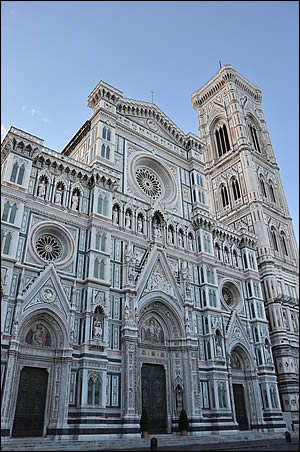
Exterior visit
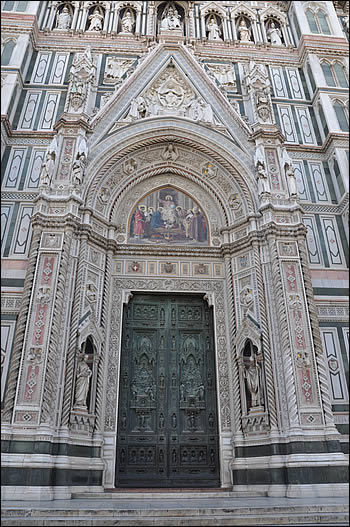
The facade is, whatever one may say, worthy of interest. The colored marbles, the mosaic and the many statues give an impression of power, but without heaviness.
The bronze doors also deserve attention.
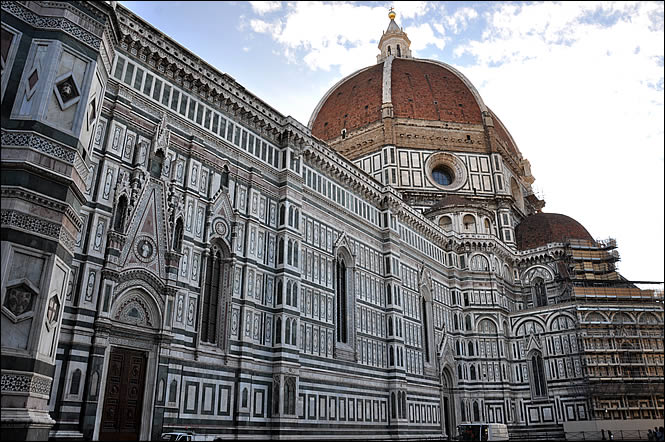
Walk around the cathedral, starting from the left, to take in its volume of white, green and pink marble, and the windows and doors for their sculptures.
The tympanum of the Porta della Mandorla shows the Assumption of the Virgin.
Do not be surprised to see the base of the dome which, because of an aesthetic problem, leaves the brick bare, after Michelangelo's taunts: he found that a first gallery looked like “a cricket cage”.
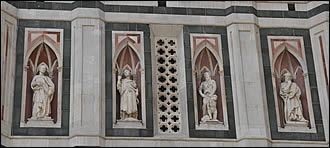
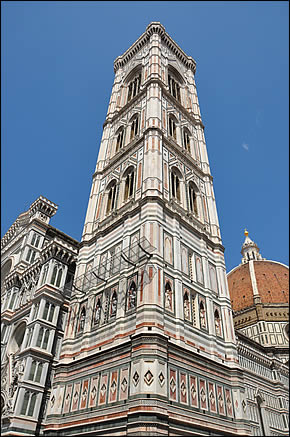
You will reach the campanile designed by Giotto but completed by Francesco Talenti. It is decorated with bas-reliefs and statues, works of the greatest masters of the Renaissance, and the originals are in the museum of the Duomo. The 28 hexagonal panels by Andrea Pisano and Luca della Robbia illustrate the Creation and various human activities. Access to the top (414 steps) offers a remarkable view over Florence.
Interior visit
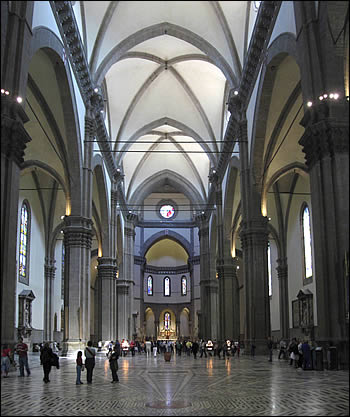
You feel a certain disappointment on entering this immense nave, for its sobriety contrasts sharply with the exuberance of the exterior.
Turn around to see a curious clock whose large hand turns backwards, indicating the hours of prayer, which begin at night.
The two frescoes of the condottieri Niccolò da Tolentino and John Hawkwood imitate bronze, certainly out of economy.
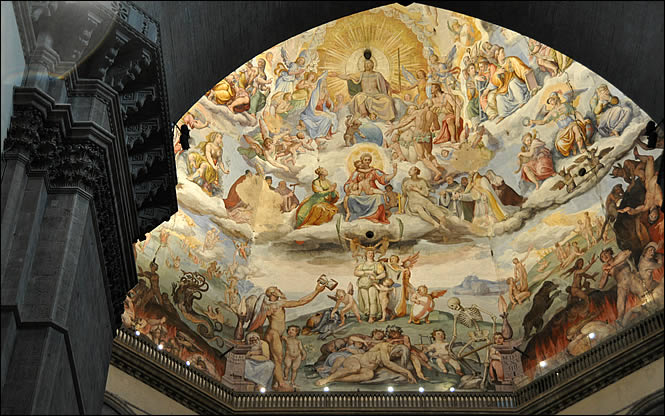
For lovers of the Divine Comedy, a fresco shows Dante before the city and its monuments. Brunelleschi's dome is decorated with an immense Last Judgment fresco painted by Vasari.
The singers' galleries, which overlooked the entrances of the two sacristies, are now in the museum of the Duomo. You can go down into the crypt to see the foundations of the old cathedral and climb to the dome (463 steps) to see the technical feat of the construction of the dome.