The church of Santa Maria Novella
You can reach the church of Santa Maria Novella from the Duomo (cathedral) by taking Via de'Cerretani and then, as its continuation, Via dei Banchi.
Address: Piazza Santa Maria Novella
Opening hours: Monday to Thursday, 9:00–17:30; Friday, 11:00–17:30; Saturday, 9:00–17:00; Sunday and public holidays, 13:00–17:00. The ticket office closes 60 minutes before closing.
Admission: €10 (church and museum).
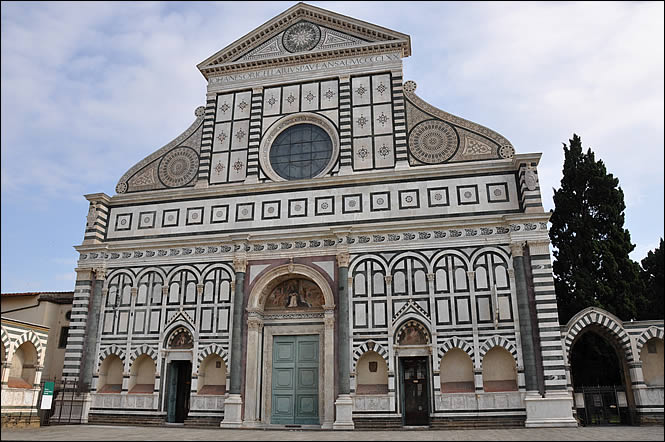
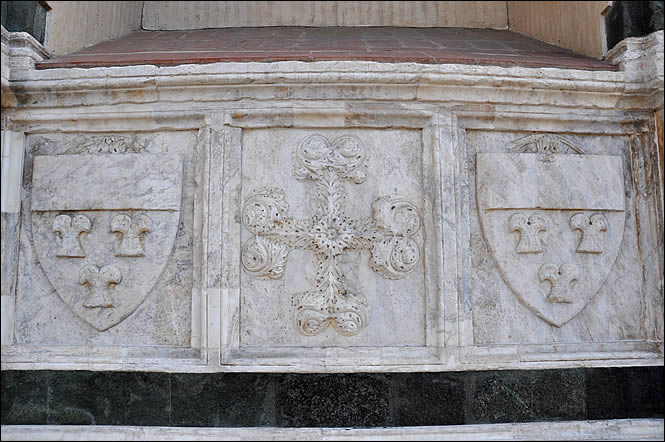
The Dominicans first occupied a modest church of the 11th century and, given the success of their predictions, it was enlarged a first time. In 1470 the architect Léon Battista Alberti was commissioned by the Rucellai family to enlarge the facade, while keeping the lower part, already inlaid with marble, and above all preserving the 6 tombs of famous Florentines in enfeu (that is, set into the thickness of a wall). A wide band ornamented with square inlays and 2 volutes in marble marquetry thus link the upper part to the lower storey.
You enter the interior through the former cemetery of the noble families of Florence and are immediately struck by its size, accentuated by an optical effect: the columns gradually draw closer to give an impression of depth.
But it is above all for its frescoes that the church draws so many visitors. On the left wall, the Trinity fresco by Masaccio was one of the first works of the Renaissance in which notions of mathematics were used to create a three-dimensional effect. The sarcophagus revealing a skeleton beneath the portraits of the donors is a trompe-l'oeil.
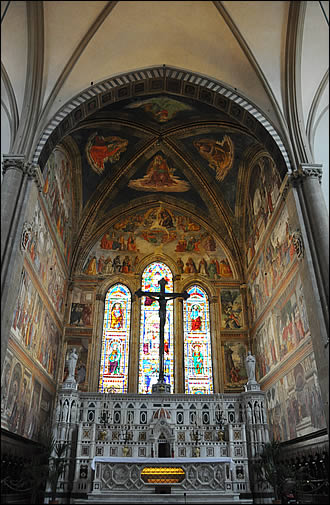
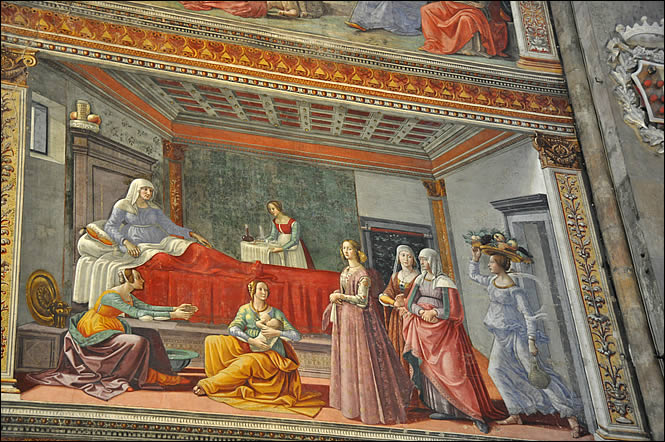
In the apse, the Tornabuoni Chapel, the frescoes of scenes from the life of the Virgin and of Saint John the Baptist are by Domenico Ghirlandaio. He includes views of Florence and contemporary figures. They are certainly the finest and most lively in the church.
In the Filippo Strozzi Chapel, Filippino Lippi illustrates the life of Saint Philip the Apostle.
The Gondi Chapel houses Brunelleschi's crucifix.
The Strozzi di Mantova Chapel is decorated with frescoes by Nardo di Cione and his brother, called Orcagna. The frescoes are inspired by Dante's Divine Comedy. Dante is depicted in the fresco of the Last Judgment.