The Church and Museum of Santa Croce
The church of Santa Croce is located on the square of the same name, which you can reach from the Duomo (cathedral) by taking Via del Proconsolo as far as Piazza di San Firenze. At the end of the piazza, turn left into Borgo de' Greci until you reach the Piazza di Santa Croce.
Address: Piazza Santa Croce
Opening hours: Monday to Saturday, 9:30–17:30, Sunday and public holidays, 14:00–17:30. The ticket office closes 60 minutes before closing.
Admission: €10 (church and museum).
Exterior
Construction of the present church began in 1294. Its dimensions were meant to compete with the church of the Dominicans, Santa Maria Novella. It was completed at the end of the 14th century, but its present facade dates only from the 19th century. The statue, to the left of the church, represents Dante.

Interior
The church has a T-shaped plan with 3 naves separated by octagonal pillars. The central nave, very wide, could support only a painted wooden roof framework.

In the transept, the Capella Maggiore has frescoes by Agnolo Gaddi illustrating the legend of the Holy Cross. The crucifix above the altar is attributed to a pupil of Giotto.
To finance Santa Croce, the Franciscans had to appeal to the generosity of rich Florentine families. In return, they asked to be buried there, and the sumptuous chapels of the transept bear their names.
Santa Croce also became the Pantheon of the personalities of the Arts and Sciences of the city. There you can see the cenotaph of Dante (he is buried in Ravenna) and the tombs of Michelangelo, Machiavelli, Rossini, Galileo and of the humanist Leonardo Bruni.
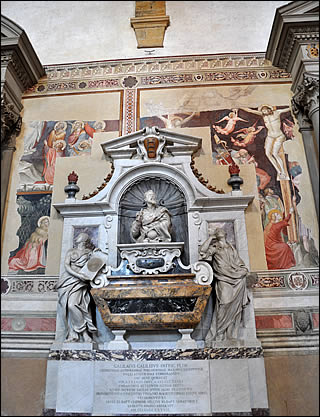

The Baroncelli Chapel, decorated by Taddeo Gaddi, a pupil of Giotto, on the theme of the life of the Virgin, leads to the sacristy and to the Rinuccini Chapel, covered with frescoes on the life of the Virgin and of Saint Mary Magdalene. The Bardi and Peruzzi Chapels were painted by Giotto himself, and he worked there for many years. These frescoes, unfortunately covered with whitewash in the 18th century, although recently restored, no longer make it possible to recover their original beauty. Another Bardi Chapel contains the wooden crucifix by Donatello.
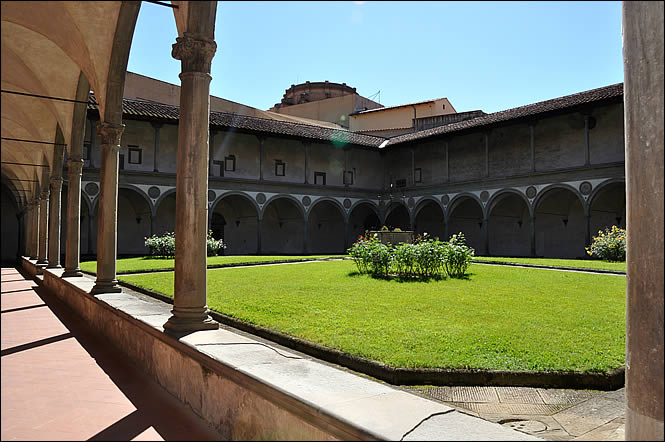
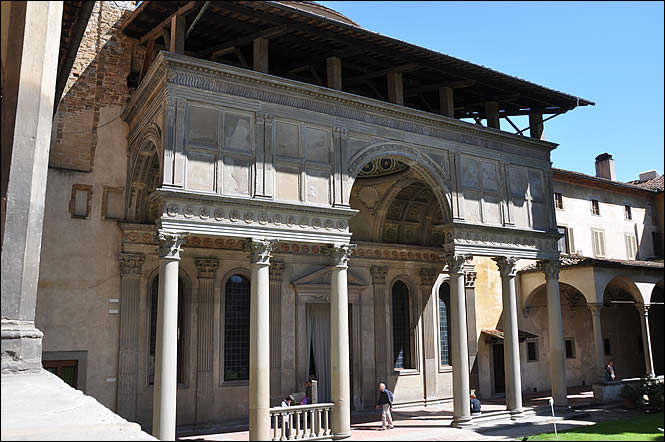
The Pazzi Chapel is located in the first cloister of the 14th century. It was to serve as a funerary chapel for the Pazzi family, but following their conspiracy (the members of the family being either executed or exiled) it remained empty. It is one of the architectural masterpieces of Brunelleschi, but it was finished only in 1470, that is, 20 years after his death.
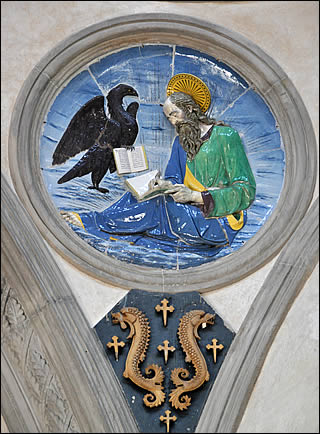
Luca della Robbia is the author of the tondi representing the Evangelists and the Apostles.
To find out more about the meaning of the symbol of the Evangelists.
Museo dell'Opera di Santa Croce
Access is through the first cloister. It holds the Christ by Cimabue, heavily damaged by the flood of the Arno in 1966. The painter breaks free from the constraints of Byzantine painting by abandoning its stiffness and its hieraticism. The end wall of the former refectory displays a Last Supper by Taddeo Gaddi and, above it, a tree of life, each branch of which, starting from the crucifix, bears the figure of a prophet of the Old Testament.

The gilded bronze statue of Saint Louis of Toulouse is by Donatello. But other works that once decorated the church are also worth seeing.
The large cloister, to the left of the Pazzi chapel, was also designed by Brunelleschi and completed in 1453 by Bernardo Rossellino.