Museo dell'Opera del Duomo – (Museum of the Works of the Cathedral)
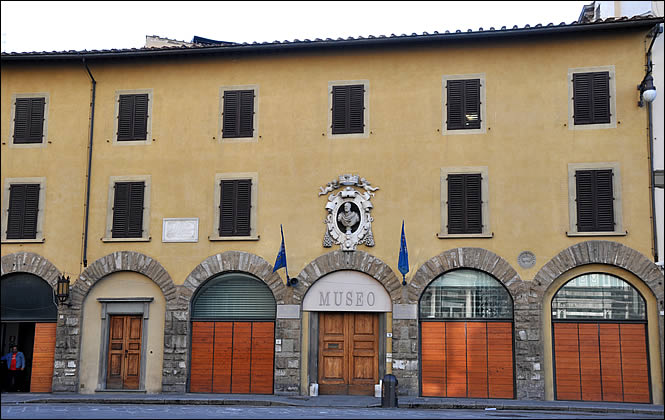
The museum is located behind the Duomo (cathedral) and was opened in 1891 in a building, formerly the seat of the Arte della Lana, and was intended to house the statuary of the cathedral and of the Baptistery. Over the years it has been enriched with many works of art from other provenances.
Recently enlarged and reopened in 2015, it houses, over an area of 6000 m2, more than 700 works from the Middle Ages to the Renaissance, which are thus shown to particular advantage in a modern and airy museography.
Address: 42 Piazza del Duomo
Opening hours: every day, 8:30–18:00. Closed on the first Tuesday of the month.
Admission: access with the Brunelleschi Pass (€30), the Giotto Pass (€20) or the Ghiberti Pass (€15), valid for 3 days.
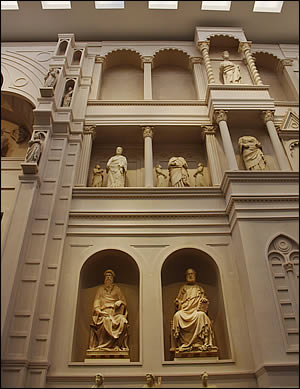
In the large, newly created room, the reconstruction of the old facade of the Duomo with the original statues makes it possible to understand and see the project of Arnolfo di Cambio.
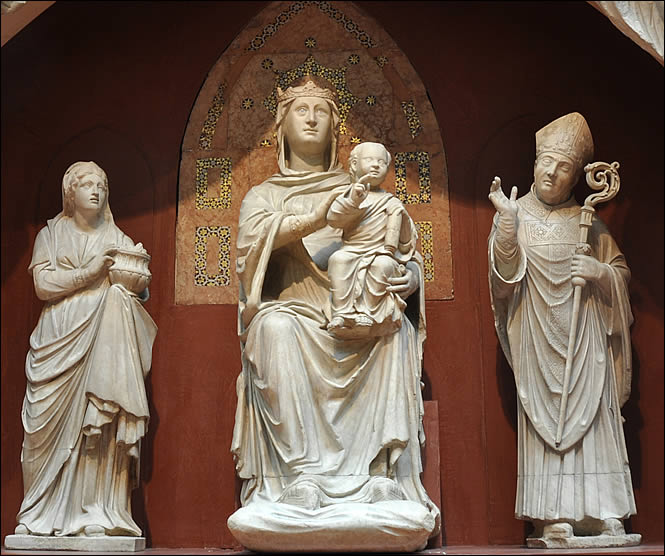
You should notice there the Virgin with glass eyes (in reality of glass paste), intended for the central tympanum and surrounded by Saint Reparata and Saint Zanobi. This group is by the hand of Arnoldo di Cambio.
There is likewise a Nativity and a Dormition of the Virgin, as well as Saint John baptizing Christ, by Donatello.
Opposite have been placed the recently restored North and East doors of the Baptistery of San Giovanni, made by Lorenzo Ghiberti. You will thus be able to admire, at your leisure, the door known as the Gates of Paradise, with its 58 panels gilded with fine gold, bordered with heads and small figures, prophets and Sibyls, and representing scenes from the Old Testament. Even if the North door suffers from the proximity of the Gates of Paradise, it is interesting to examine it closely, because Ghiberti introduced perspective there in scenes rich in detail.
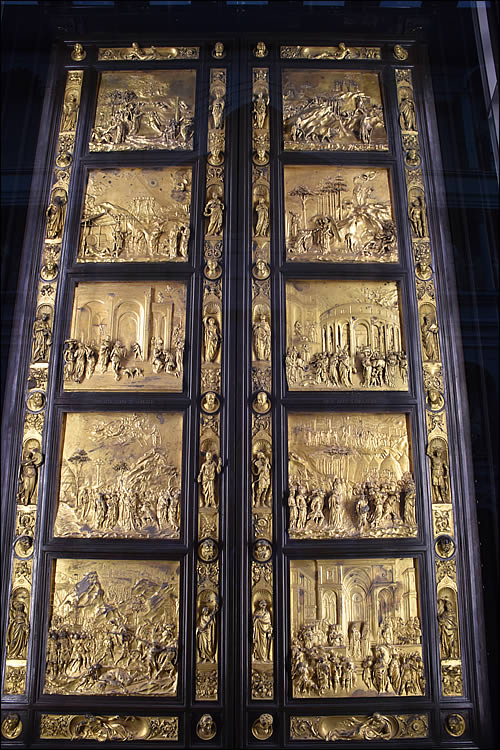
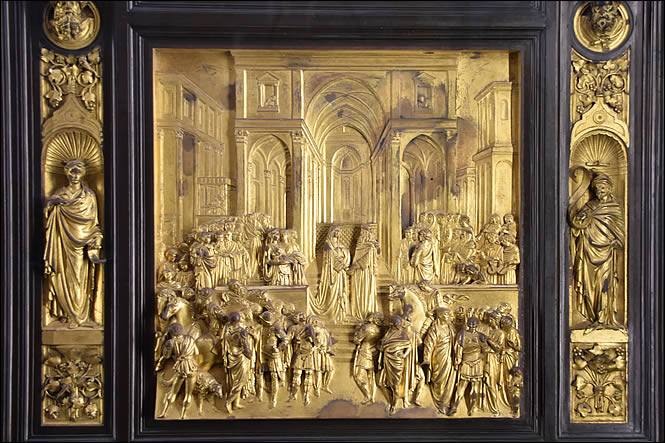
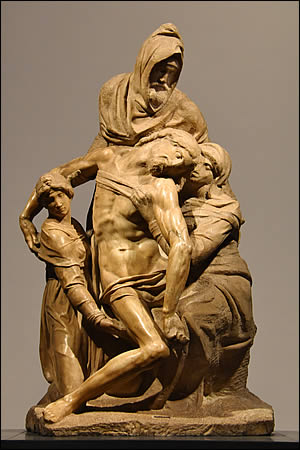
Two major works have been placed in rooms that are practically dedicated to them.
This is the Pietà, the last work of Michelangelo, which he intended for his own tomb, but which, dissatisfied with his work, he began to destroy.
It was fortunately saved by one of his pupils, then repaired and completed by the Florentine sculptor Tiberio Calcagni.
It was afterwards sold to Francesco Bandini, whose name it bears, then acquired by Cosimo III de' Medici.
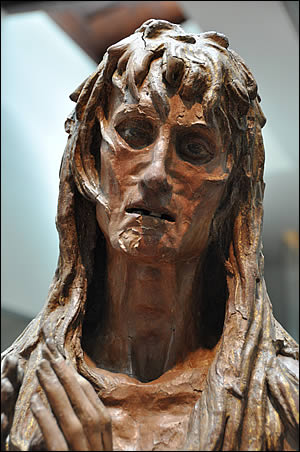
The Magdalene, a wooden sculpture made by Donatello, had been placed in the Baptistery of San Giovanni.
It suffered greatly from the floods of the Arno in 1966, but, restored, it is now protected in a glass enclosure.
To find out more about Mary Magdalene
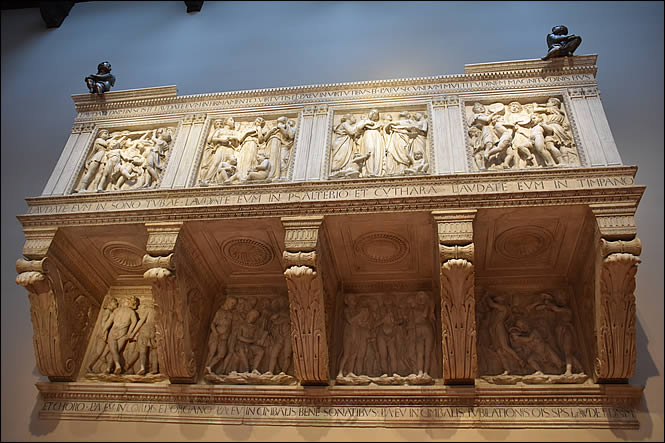
The singers' galleries (cantorie), one made by Luca della Robbia and the other by Donatello, are placed facing each other at their original height, but reproductions of the little singers and putti are placed at eye level.
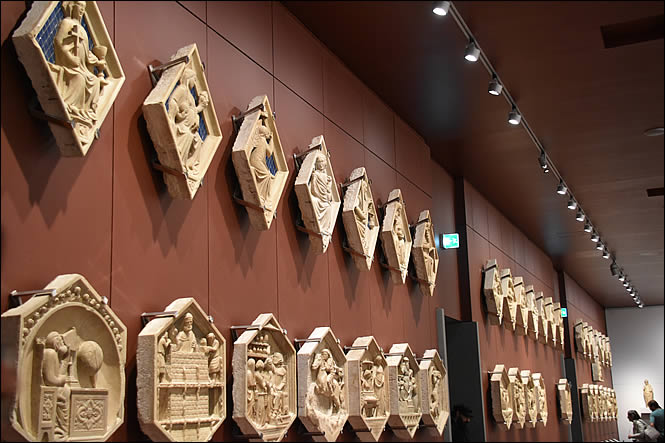
A long gallery houses the statues from the campanile, among them the prophet Habakkuk by Donatello, nicknamed “pumpkin head” for his baldness and the shape of his skull. Opposite are placed the reliefs of the campanile, which highlight the positive role of Man in his works and labors. These hexagons also illustrate religious scenes, such as the creation of Adam and Eve, and mythological ones, such as Daedalus in flight or Orpheus charming the wild animals with his music.
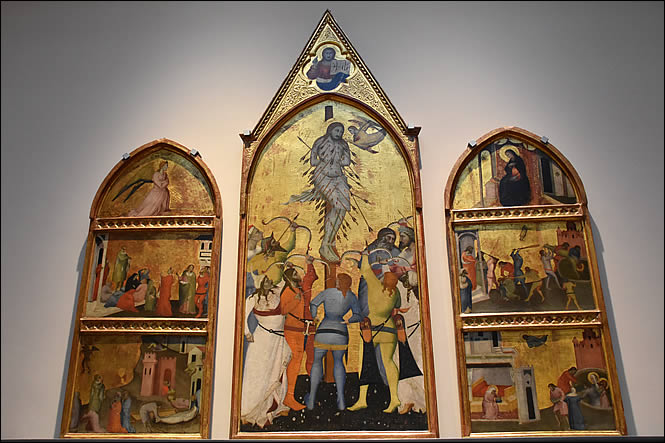
The museum is also rich in religious paintings, essentially altarpieces, one of which illustrates the life of Saint Reparata, the patron saint of Florence. To find out more about Saint Reparata.
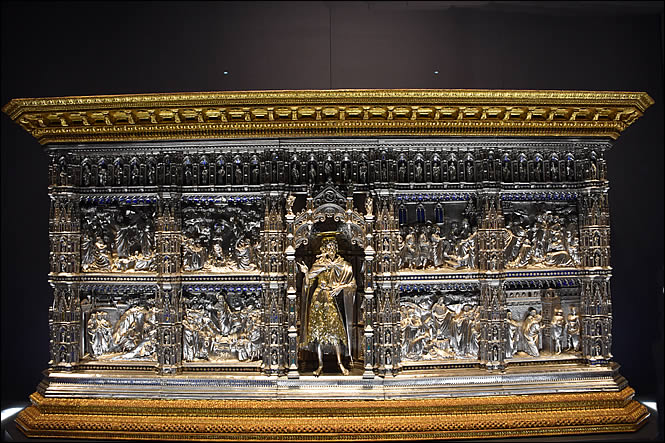
The silver altar of the Baptistery of San Giovanni, a major work of the Renaissance, has regained all its splendor after a meticulous restoration that lasted several years.
A room contains models, plans and tools used for the construction of Brunelleschi's famous dome, and makes it possible to see the complexity of the work he had taken on.
A visit to this museum is strongly recommended as a complement to the visit to the Duomo, whose austere interior can leave a feeling of frustration.